
Custom Geosynthetic Solutions for Landfill Projects
Geosynthetic Solutions are changing the way landfill projects are approached, guaranteeing environmental safety, better efficiencies, and overall stability. Modern landfills are engineered ecosystems, so proper planning and efficient materials are needed.
In today’s world, where landfills have to adhere to strict regulations and environmental considerations, such materials should offer reliability and sustainability. Thanks to advances made in the sector, such solutions are possible due to innovations coming from the best geotextile manufacturers in India. Examples of materials that have been employed include the geocell structure and geogrid reinforcement system.
What Contributes to Successful Containment and Environmental Protection with Geosynthetic Solutions
The initial step towards ensuring the safety of landfill sites is that of containment, though not necessarily as easy as just lining the area up. As waste produces leachate over time, any potential flaw in the containment process results in lasting harm to the environment.
Here, Geosynthetic Solutions play an important role. The materials employed here help prevent seepage of waste products through soil and groundwater without affecting their durability despite the presence of mechanical stress, chemical reactions, and environmental changes.
Additionally, in landfill construction projects, reinforcement of soil with geogrid systems and utilisation of geocells have been implemented as well for enhanced stabilisation.
In the end, the system works to contain the waste material as well as the entire landfill ecosystem at once.
How is Effective Drainage and Leachate Control Achieved
Drainage and leachate management can be considered one of the critical stages in designing landfill systems. The problem of inadequate drainage results in pressure accumulation, which, in its turn, may weaken all structural layers, increasing contamination risks for the landfill system as a whole.
The utilisation of geosynthetics can help maintain efficient drainage, as these materials provide drainage channels while preventing soil from entering them and causing clogging problems. Proper drainage and flow management decrease internal stresses within landfill structures.
Moreover, advanced use of geocell systems helps achieve enhanced controlled water flow channels where the soil is heterogeneous.
Why is Structural Stability Important for Landfill Functioning
Landfills are living structures that experience a series of load variations with the continuous depositing of waste into the site. Sub-grade weakness can cause uneven settlement, which further impacts the whole containment system.
Reinforcement layers are applied for base stabilisation purposes to even out the loading process and prevent deformation. Thus, stability is ensured throughout the entire process.
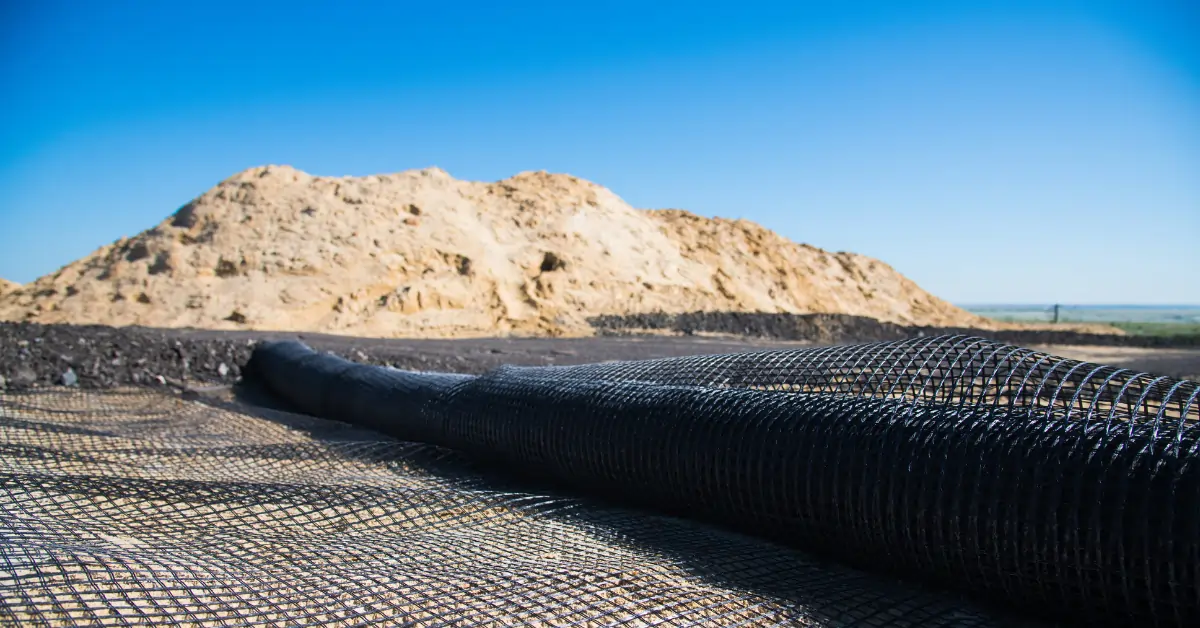
Finally, landfill constructions employ the usage of geogrid reinforcement systems that ensure proper reinforcement of weak layers of the soil.
Base stability is equivalent to the proper functioning of all upper layers in a landfill system.
How do Landfills Adjust to Site Constraints
Every landfill construction site is unique. Soil types, moisture content, and other physical characteristics vary depending on geographical location and site conditions.
A landfill system must be capable of adjusting its function accordingly. The application of geosynthetics will offer adaptability through the provision of flexible materials that can easily fit in different types of soils and environments.
Adaptability is achieved despite the softness or ruggedness of soils. Moreover, such soils, which can be soft and non-uniform in structure, present no challenge to the geocell system since it will help reinforce soil structure and provide additional load-bearing capabilities.
How Are Maintenance Difficulties Reduced in Landfill Projects
Maintenance in landfill projects is costly. Once there is a problem, there will be a need for extensive excavation in order to restore the operations to normalcy.
However, with the use of strong materials during construction, one can avoid this situation. This makes it easier to maintain and manage operations.
Use of robust geogrid reinforcement systems eliminates many potential hazards during operation and maintenance.
The main emphasis in such projects should therefore be on performance planning rather than maintenance.
What Facilitates Successful Sustainable Operations in Landfills
Sustainable landfill operations are important aspects of such projects. In order to facilitate sustainability in the projects, it is imperative to develop a system that performs optimally throughout.
Containment, drainage, and stability are some of the considerations when setting up the landfills. This facilitates optimal performance in the project.
Why are Geosynthetic Solutions Important for Modern Landfills
The application of Geosynthetic Solutions in landfill construction extends beyond just the conventional use of materials; it implies an entirely new era of more intelligent, safe, and sustainable disposal techniques. Integrating containment, drainage, and reinforcement features into one solution solves a variety of issues in one go, thus making them highly essential in today’s landfill construction practices. Given the ever-changing environmental laws and regulations, innovative materials will continue to play a key role in constructing efficient infrastructure.
How Does Supreme GeoTech Provide Reliable Landfill Solutions
Supreme GeoTech, known to be a Technical Textile Manufacturer, is renowned for its expertise in providing geosynthetic materials used in landfill construction. Being experts at what we do, we make sure that every aspect of their process, from designing to implementing the construction, is taken care of in the best possible way. Offering customised solutions to every project, Supreme GeoTech guarantees efficient and sustainable construction of infrastructure facilities.
FAQs
How does the use of geosynthetics avoid landfill contamination?
This helps in creating an obstruction which ensures that the hazardous substances cannot leak into the soil and water.
Why is it necessary to manage waste in landfills now?
Because we generate about 2 billion tonnes of waste in one year, proper management is very important for environmental reasons.
What kind of geosynthetics can be found in landfills?
Different kinds of geosynthetics, like liners, drainage systems, geocell structures, and geogrid reinforcement layers, can be found there.
How do geosynthetics help in protecting groundwater?
It prevents contaminated liquids called ‘leachates’ from entering the ground.
Are geosynthetics effective for many years to come?
Yes, they are effective in the sense that they work efficiently for hundreds of years.
Is the use of geosynthetics environmentally friendly?
Yes, their use is definitely environmentally friendly and sustainable.